Category: Event

Nominations Now Open for Midlothian Volunteer Awards 2026!

We are thrilled to announce that the nominations for the Midlothian Volunteer Awards 2026 are officially open! 

This annual event is an opportunity for us to celebrate and acknowledge the incredible contributions and achievements of our dedicated volunteers. Volunteers play a significant role in boosting the welfare of our community, and Volunteers’ Week is the perfect opportunity to celebrate them.

This year’s awards ceremony will be an unforgettable moment, celebrating the individuals who go the extra mile to make lasting and positive impacts within their community. We strongly encourage everyone to take the opportunity to nominate a volunteer they know who has made considerable impacts throughout their volunteering journey.

This year we are introducing a new award category, Uniformed Volunteer. This award wishes to acknowledge and thank all the volunteers who contribute to our community through uniformed organisations like Scouts, Youth Police Volunteers, Cadets, and many more.  

We have also introduced the Dedicated Service to the Community award, combining the Service to the Community and Dedicated Service to Volunteering categories. This award wishes to acknowledge all the volunteers who contribute towards significant services, organisations and causes within their local community and is a thank you to those who donate their time to make our community the best it can be.  

We value our volunteers and the profound effects their hard work leaves on Midlothian and those living in the area. We would like to thank all volunteers for their amazing work and commitments to the community, and we are eager to share their empowering stories at our awards ceremony this year.  

Nominations are due to close on Monday 20th April 2026, so if you would like the opportunity to highlight someone who deserves to be acknowledged for their efforts, send in your nomination soon and help us honour those who go above and beyond for our community.  

Read our FAQs on the Midlothian Volunteer Awards page before submitting your nomination.

Nominations for the Midlothian Volunteer Awards 2026 are now open!

Deadline for nominations: Monday 20 April 2026.

Midlothian Volunteer Recruitment Fair Returns for 2026

The start of the new year is the perfect time to make a positive change, and volunteering is a great way to do just that. The 2026 Midlothian Volunteer Recruitment Fair is the ideal event to explore what’s out there and take the first step.

The fair will take place on Thursday 26 February, from 10am to 2.30pm, at St John’s & King’s Park Church in Dalkeith. This annual event is organised by Midlothian Community Action (MCA) to promote volunteering and encourage conversations between local volunteer-involving organisations and people who want to get involved.

Volunteering can help people build skills and experience, boost their CV, and gain confidence. It’s also a great way to meet new people and feel part of the community. Young volunteers can work towards the Saltire Award, the Scottish Government’s recognition scheme for volunteers aged 12-25.

A variety of organisations from across Midlothian will be attending the event, including:

Marie Curie, VOCAL, Penicuik Storehouse, Gig Buddies with Thera Trust, Midlothian Sport & Leisure Wellbeing Team, St Joseph’s Services, Fostering Compassion, Salvation Army, Dalkeith Citizens Advice Bureau, Chest Heart & Stroke Scotland (CHSS), and Midlothian Sure Start – with more expected to join.

MCA’s Volunteer Support Officer, Sarah Bain, said about the fair, “There’s a volunteering opportunity for everyone, and this event helps people find the one that’s right for them. Every year, I’m inspired by how many step forward to make a difference”.

The fair is open to everyone and there’s no need to book. Drop-in anytime between 10am-2.30pm on Thursday 26 February at St John’s & Kings Park Church, Dalkeith, EH22 1HJ.

Download the poster below to help us spread the word!

END


Follow MCA on social media so you never miss an event:

Midlothian Demands Better: Banner Making for Change

As communities across Scotland prepare to march for a fairer future, Midlothian is getting creative. On Thursday 23 October, local residents, community groups, and campaigners are invited to join Midlothian Community Action at One Dalkeith for a banner-making session ahead of the Scotland Demands Better march in Edinburgh.

Hosted in partnership with Midlothian Climate Action Network, the event – titled Midlothian Demands Better – is a chance to come together, share ideas, and make banners that reflect the local issues we care about most. Whether it’s housing, transport, wages, or public services, we’ll be exploring what “better” means for Midlothian.

Materials will be provided, and attendees are encouraged to bring cardboard or reusable items to keep things sustainable. There’ll be tea and biscuits, – and plenty of space to chat, create, and connect.


Why We’re Marching

Scotland Demands Better, organised by The Poverty Alliance, is a non-partisan march and rally taking place on Saturday 25 October in Edinburgh. It’s a call for:

  • Better jobs for everyone who needs one, with fair conditions and wages that pay the bills.
  • Better investment for life’s essentials, like affordable homes, good public transport, a thriving natural environment and strong public services.
  • Better social security so that all of us have a foundation for the future.

Change for the better happens when people stand together and demand it. Scotland needs that change. Too many are struggling to afford life’s essentials. Too many are going hungry, living in cold homes, or working jobs that don’t pay the bills. This march is about standing together to say: we deserve better.

The march will assemble from 10am at the Scottish Parliament, proceeding along the Royal Mile to George IV Bridge and concluding at The Meadows with a rally involving music, speeches, stalls and workshops.

Midlothian’s Voice Matters

The banner-making session is part of a wider effort to ensure Midlothian’s voice is heard. What would “better” look like here? What are the local demands we want to amplify?

Whether you’re a volunteer, staff member, activist, or simply curious, everyone is welcome. Come along, get creative, and help us make sure Midlothian has strong representation at the Scotland Demands Better march.

END.


Sign up for our newsletter so you never miss an event, or follow us on social media:

Midlothian Leads the Way in Trauma Awareness & Wellbeing

As Midlothian marks its first-ever Trauma Awareness Week, we are also excited to announce the opening of the Communities Mental Health & Wellbeing Fund—an important step towards supporting local initiatives that enhance mental health and wellbeing across our communities. With £249k available to local organisations, this fund is a unique opportunity to create lasting change, just as Midlothian’s Trauma Awareness Week is helping to set the stage for greater understanding and support around mental health.

Midlothian Trauma Awareness Week: A First For Scotland

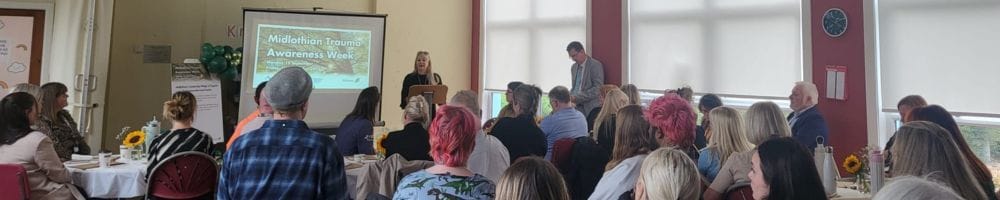
This week, Midlothian is leading the way with the first-ever Trauma Awareness Week in Scotland. Launched by Midlothian Council, the week focuses on key principles of trauma-informed care: Collaboration, Trust, Safety, Empowerment, and Choice.

In her opening speech at the launch event on Monday, Midlothian Council’s Chief Executive, Dr Grace Vickers, shared the aims and goals behind this initiative:

“The aim of the week is to raise awareness and understanding of the impact that trauma can have on individuals, families and communities, while also showcasing the positive and supportive steps that staff, services and organisations across Midlothian are taking to support everyone to grow, recover and thrive.”

The week focuses on key principles of trauma-informed care: Collaboration, Trust, Safety, Empowerment, and Choice. Events will run throughout the week, providing local professionals and community members training on how to support those affected by trauma.

The Communities Mental Health & Wellbeing Fund

As Midlothian’s Trauma Awareness Week wraps up this Friday, MCA are excited to open applications for the Communities Mental Health & Wellbeing Fund, with a total of £249,914.16 available in year 5 to support local projects. The fund has a strong emphasis on collaboration, partnerships, capacity building and the development of creative projects that can work at a very grassroots level, together with local people.

One important aspect of the fund is its focus on trauma-informed practice. As Midlothian embraces trauma awareness and works towards becoming a trauma-informed community, it’s vital that organisations receiving funding can demonstrate a commitment to this approach. All successful projects will given support to access free trauma-informed training.

The Communities Mental Health & Wellbeing Fund is now open for applications, with three distinct grant streams to choose from. Whether you’re offering direct mental health support, creating safe spaces for individuals to connect, or providing education on wellbeing, we encourage you to apply. The deadline for applications is Friday, 31 October at 12PM.

END.

Is your organisation ready for AI? | Q&A with Dr Louise Drumm

AI isn’t the future – it’s already here, and it’s changing the way people work across every sector.

We’re aware that the third sector is having ever-increasing demands put on them, and we can’t keep working in the way we have been. That’s why we’ve partnered with Edinburgh Napier University to host an Innovation Morning, to look at how local third sector organisations can harness AI and automation to safely and ethically make us more effective. We’ll also be joined by Business Gateway Midlothian and Tyne Esk Clld Fund to find out what expert support and funding there might be available to help us innovate in other areas.

Whether you’re new to AI or already using it to streamline admin tasks or analyse data, this event will help you build confidence, understand risks, and make the most of the tools available.

Meet Dr Louise Drumm, Our Guest Expert

The AI session is being led by Dr Louise Drumm, Associate Professor in Digital Education in the Department of Learning and Teaching Enhancement at Edinburgh Napier University. We asked her a few questions ahead of the event.

Can you tell us about your background in Digital Education and your research into AI?

“I’ve worked in universities across Scotland and England for over 20 years, and I’m interested in all the ways that technologies can support – or sometimes hinder – learning and working. I teach others how to design and deliver online or use technology effectively in the classroom, and I’m always reflecting on how I use technology myself, whether personally or professionally. I’ve also researched attitudes and experiences around generative AI among learners, educators, and other professionals. Generative AI brings exciting opportunities for how we work and learn, but we need to think carefully about what appropriate and responsible use looks like.”

When we talk about GenAI, what exactly do we mean?

“GenAI is newer development within the much larger and older field of artificial intelligence. It refers to a range of easy-to-use tools which create content – whether text, images, video or audio – in response to a user’s request. These systems are trained on vast datasets and use patterns in that data to generate content that can feel quite human-like. Some people describe GenAI like ‘predictive text on steroids’ and I like this description because sometimes it can get things wrong, just like predictive text. Well-known GenAI tools include Copilot, Google’s Gemini, ChatGPT, Dall-E, but more GenAI is being integrated into other tools like Microsoft Word, Canva, Grammarly and even Google search results.”

Why did you approach MCA from Edinburgh Napier University to run this workshop?

“I am keen as a researcher to share my expertise with different communities and to find out more about how people are using AI in their work. We were keen to work with a wide cross-section of third sector organisations and approached MCA as they have such a strong network across Midlothian. The event is supported by Napier’s public engagement team and funding, and we are always happy to discuss any future collaborations.”

How are charities and third sector organisations already using AI in their work?

“The areas which these organisations seem to be using AI are streamlining admin, fundraising, service delivery, and data analysis. However, according to The Software Bureau it is mainly larger charities who have embedded GenAI and are benefiting from its use, and only 6% have a formal AI policy, with over half of staff having received no AI training.”

Some people are concerned that AI is unethical or even dangerous – how do you respond to these concerns?

“There are many complex ethical issues with AI, even for an individual user. The first priority is always to ensure we are acting within the law. But beyond that, there are also serious concerns about how these tools are developed and used, such as their environmental and societal impact, to name just two. I always advocate for making informed choices about any tool that we use, so this means engaging with reliable evidence and making decisions based on knowledge, not than hear-say or the hype on social or other media, which can lean towards extreme pro- or anti- GenAI views. A little understanding goes a long way, and I fully support anyone who, having thought through the ethical implications, decides that GenAI use is not right for them.”

What can attendees expect to take away from the Innovation Morning?

“Whatever your current knowledge about GenAI – whether you are completely new to it or already experimenting – you can expect an interactive session designed to help you to think through the pros and cons of using GenAI in their work. You’ll have the chance to get hands-on with some GenAI tools, explore real life examples relevant to you, and take away practical resources which you can use in your role straight away. The focus will be on making informed, responsible choices – no technical expertise required.”


END.

Overdose Prevention: Key Lessons from Our Naloxone Training Session

Last week, MVA held a Naloxone training and harm reduction session for third sector staff and volunteers in Midlothian. The session was delivered by Ross Ballantine, Clinical Support Worker with the Midlothian Substance Use Service, and David Boyd, Harm Reduction Worker from MELD and the Scottish Drugs Forum.

National Context

Scottish mortality rates to drug misuse and related deaths are the highest in Europe. The annual National Records of Scotland report provides insightful statistics of the ongoing drug crisis:

  • In 2023, 1,172 people in Scotland died due to drug-related causes—a 12% increase from the previous year.
  • Opiates and opioids were implicated in 80% of all drug-related deaths.
  • People living in the most deprived areas of Scotland are more than 15 times as likely to die from drug misuse compared to those in the least deprived areas.
  • Drug-related deaths have been steadily rising since 1996, with a much steeper increase since 2013.

This stark reality reinforces the need to raise awareness of harm reduction approaches.

Harm Reduction & Lived Experience

During the session David spoke of his own lived experience, sharing his journey through different support services, the mindset change that led to him to recovery, and the harm reduction work he does now. David’s message echoed a quote from Johann Hari,

“The opposite of addiction is connection.” – Johann Hari

His story serves as a powerful reminder of the role community, support, and understanding play in recovery.

Hearing David’s real-life experiences emphasises the importance of involving those with lived experience in service delivery. It underlines the significant impact that partnerships between mental health professionals, wellbeing staff, and individuals with lived experience can have in delivering more comprehensive support.

Following the discussion on harm reduction, participants were trained on how to recognise an overdose and administer naloxone.

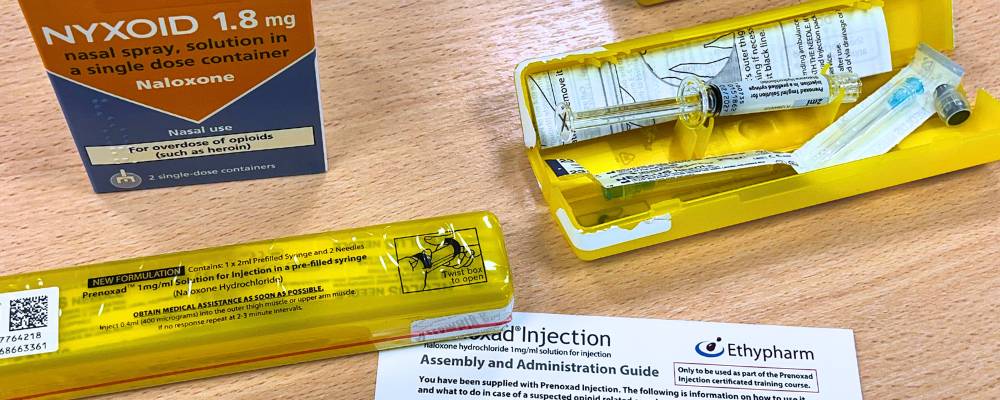
Two injectable naloxone kits, one is open and shows inside a sealed Prenoxad injection and needle. In the background is a small box of 'nyxoid' - the nasal spray solution.

What is Naloxone?

Naloxone is a life-saving medicine that can temporarily reverse the effects of opioids in the event of an overdose. It works by blocking opioid receptors in the brain, restoring normal breathing for someone who has stopped or is struggling to breathe due to an overdose. Administration of naloxone provides crucial time for emergency services to arrive and for further treatment to be given. In the UK it is legal for anyone to administer naloxone to anyone for the purpose of saving a life.

Always call 999 if you think someone is having an overdose. Administering naloxone is not a substitute for calling an ambulance.

How is Naloxone Administered?

In Scotland, naloxone kits can come in two forms:

  • Nasal Spray (Nyxoid): A quick and easy method that involves spraying Naloxone into one of the person’s nostrils.
  • Injectable (Prenoxad): A pre-filled syringe that can be injected into the muscle, typically in the thigh, buttock, or upper arm.

Scotland’s National Naloxone Programme

Scotland was the first country in the world to introduce a national naloxone programme. The Scottish Government established the programme in 2010, aiming to reduce opioid-related deaths. Through this initiative, take-home naloxone kits are made widely available to those at risk of overdose, as well as to people who are likely to witness an overdose, such as family members, friends, or workers in the community. The availability of take-home naloxone has become even more crucial as Scotland faces a rise in synthetic drugs and polydrug use, both of which are contributing to the country’s alarming overdose statistics.

Takeaways from the Session

While the session offered practical naloxone training, the broader conversation touched on the challenges faced by third-sector and public services in supporting people with addiction. Cuts in funding resulting in low staff retention and reductions in services, make it difficult to provide consistent, trauma-informed care. Addressing these systemic issues is critical to improving outcomes for service users.

A recent report by the Scottish Drugs Forum gives insights into the experience of people in Medication Assisted Treatment (MAT), identifying the need to improve treatment. You can read the report here.

Special Thanks

We are incredibly grateful to Ross Ballantine for organizing the training and supplying take-home Naloxone kits, and to David Boyd for sharing his lived experience—his openness brought an important perspective to the session. Ross & David are happy to arrange similar training for organisations & volunteers in Midlothian. Please contact MVA for more details.

Getting the Message Out

As we continue to push forward with harm reduction efforts, it’s vital to raise awareness of harm reduction strategies like the provision of naloxone. Campaigns like #StopTheDeaths and International Overdose Awareness Day aim to amplify this message, ensuring more people understand how they can help prevent overdoses in their communities. You can find out more in the resources linked below.

We can all do something to help prevent drug related deaths.


Relevant Resources


Authored by Ellis Paterson.

Third Sector Funding: Have Your Say

MVA are hosting an online session on Tuesday 13 August, 14:00-15:00 to discuss the Social Justice and Social Security Committee’s third sector funding principles consultation.

This is our opportunity to tell the Scottish Government how they can improve their funding to make it fair, flexible, sustainable, and accessible to ensure that third sector organisations can keep providing the services and projects that are crucial to communities across Scotland.


In this session, we’ll dive into key questions and gather feedback to create a combined response to the consultation. We also encourage everyone to submit their own response before the deadline on August 16.

What is the Aim of the Consultation?

The Social Justice and Social Security Committee seeks to address the significant challenges faced by the third sector, including recovery from the pandemic, the cost of living crisis, years of underfunding, and poor funding practices. The Committee want to hear from both funded and funding organisations, to understand what can be done now to make the public funding process more efficient and sustainable. By submitting our views on the Scottish Government’s approach to funding, we can help champion the need for Fair Funding.

When Does It Close?

The consultation closes on Friday 16 August. Make sure to share your feedback before the deadline to ensure your voice is heard.

What Do We Mean by Fair Funding?

Fair Funding, as defined by the Scottish Council for Voluntary Organisations (SCVO), is a funding landscape that is fair, flexible, sustainable, and accessible. This includes longer-term funding models, accessible and consistent processes, and more unrestricted funding with in-built uplifts.

SCVO has divided their Fair Funding calls into four distinct definitions – multi-year funding, sustainable funding, flexible funding, and accessible funding. Read more on their website.

Consultation Background

For almost a decade, the Scottish Government has acknowledged the need for multi-year funding. In April 2023, the policy prospectus ‘New leadership – A fresh start’ committed to achieving fairer funding by 2026. Despite this, little progress has been made, highlighting the need for this consultation.

What Are the Questions?

The consultation includes specific questions for third sector organisations, covering five key topics. These will be discussed in our online session:

Longer-Term Funding Impact:

  • How would a shift to longer-term funding of three years or more support your organisation?
  • What specific challenges do you foresee in transitioning to such a funding model?
  • If relevant, please provide any specific examples of how your organisation has been affected by a lack of longer-term funding certainty.

Flexibility and Core Funding Needs:

  • In what ways would flexible, unrestricted core funding enhance your organisation’s operational effectiveness and governance?
  • What specific challenges do you foresee in transitioning to such a funding model?
  • If relevant, please provide any specific examples of how your operational effectiveness and governance have been affected by a lack of flexibility in your core funding.

Sustainable Funding and Inflation Adjustments:

  • How critical are inflation-based uplifts and full cost covering, including core operating costs, to the sustainability of your organisation?
  • What impacts have you observed or anticipate without these adjustments in your funding?
  • If relevant, please provide any specific examples of how your organisation’s sustainability has been affected by a lack of inflation uplifts and/or full cost covering.

Real Living Wage Commitments:

  • What challenges does your organisation face in ensuring all staff are paid at least the Real Living Wage?
  • How would improved funding arrangements support your organisation to meet this commitment?

Efficiency in Funding Processes:

  • What improvements in the application, reporting, and payment processes could make the funding system more efficient for your organisation?

More Information

Read more about the consultation here.

Read SCVO’s blog here.

Register for our online session here.

Let’s make fair funding a reality for Scotland’s #EssentialSector