We’re running a lunchtime session to offer advice & support for anyone interested in applying for Year 5/ 6 of the Midlothian Communities Mental Health & Wellbeing Fund.
The Communities Mental Health & Wellbeing Fund provides grants supporting initiatives in Midlothian that improve adult mental health & wellbeing. The fund opens for applications on Friday 19 September 2025 and closes on Friday 31 October, 12PM.
During the session, we’ll cover:
Eligibility
Fund Requirements
What the Fund Can Be Used For
Fund Timeline & Scoring Process
Tips & Advice for Successful Funding Bids
Details
This session will be held online via Teams, the link to join will be available when you register. If you have any questions about this session, please email us at info@mca.scot
Can’t make this one? Don’t worry, we’re running another lunchtime session on Wednesday 24 September – book here!
Want 1:1 advice? There will be an online fund surgery on Monday 22 September. Email magdalena.clark@mca.scot to book a slot.
It was a wonderful chance to highlight the impact of the fund on a variety of projects across Midlothian. Thank you to everyone who joined us and took part in celebrating these incredible projects. Presentations from the day are available to download below.
Edinburgh Community Yoga
Edinburgh Community Yoga is a not-for-profit social enterprise working to make yoga and its many potential physical, mental, and social benefits more accessible to those who may benefit the most. ECY aim to minimise the financial, attitudinal and accessibility barriers that may prevent someone from attending a public yoga class by prioritising inclusivity.
ECY received a small grant for their programme of yoga on social prescription, where they partner with GP practices and local agencies to offer (by referral) onsite trauma-informed yoga in areas of social and economic deprivation.
Mayfield & Easthouses Youth 2000 Project (Y2K) was set up by the local community to provide universal youth work services using an informal, service-user led approach.
Y2K received a large grant for their Thriving Transitions project to support young adults during their transition to adulthood and greater independence.
Dalkeith Petanque Club received a micro-grant for necessary equipment for their Piste in Dalkeith. Their story highlights the brilliant partnership working in Midlothian and how community groups can make a huge impact with a little support.
Home Link received a large grant, working in partnership with Midlothian Sure Start to run a weekly wellbeing support group for parents with children who have additional support needs.
Women”s Aid East and Midlothian received a continuation of their Year 2 large grant, plus capital. This went towards implement Green Recovery of Women (GROW), a social green prescribing method, into their service delivery.
Of course, it wouldn’t be a Meet the Funder event without the funder. We were thankful to be joined by the Wellbeing & Prevention Unit Communities Team from the Scottish Government Mental Health Directorate, who provided more details about the CMHW Fund provision so far, and an overview of what’s to come.
Year 3 of Midlothian Community Mental Health and Wellbeing Fund for Adults launched in the end of September 2023 distributing over £246 thousand to third organisations and community groups. It has already seen many successful applications for larger projects. There is a small fund of £7800 to support micro grant applications, to be distributed by the end of March 2024. The Fund aims to support people’s good mental health and wellbeing and to provide opportunities to connect with others in local community.
Local groups are invited to apply for funding from £200 up to £2500.
Known as “the Sunflower Fund” the funding has a strong emphasis on collaboration, partnerships, capacity building and the development of creative projects that can work at a grassroots level, together with local people. All these to ensure outcomes are inclusive and have maximum impact on a local level. In Midlothian the fund had been overseen by a team of staff and volunteers from the TSI, Midlothian Council, Health in Mind, and Midlothian Health and Social Care Partnership. The Lived Experience Working Group from Health in Mind will be assessing the funding applications.
MAEDT is a community development trust dedicated to creating opportunities and improving outcomes for the local community of Mayfield and Easthouses. A key value of the Trust is to work towards alleviating poverty. With that goal in mind, MAEDT runs a wide range of different projects that share one key thing in common: the creation of long-term solutions for local people.
MAEDT has been running since 2007 and new projects are continuously being introduced, including the Community Food Pantry which recently celebrated its one-year anniversary. As well as the pantry, MAEDT runs and hosts projects including a school uniform bank, debt and energy clinics, drop-in sessions with the local Citizens Advice Bureau, employability support, a men’s mental health group, a kinship carers group and a ‘wheelbeing’ hub for bicycle repairs and socialising. Central to these groups and projects is MAEDT’s pavilion, community garden and café, where a hub of different activities take place on a daily basis, come rain or shine.
MAEDT’s Pantry and Pavilion
Over the last 2 years, MAEDT saw how the pandemic increased unemployment and food bank referrals in the Mayfield and Easthouses area. Wanting to focus on reducing food poverty and improving people’s access to healthy food, MAEDT introduced a community food pantry. ‘The Pantry’ is a shop where food items are marked as either 1 or 2 credits each, and shoppers can buy 10 credits for £3.50. In addition to the credits, members are offered free fresh fruit and vegetables, sanitary products and bakery items.
To shop at the Pantry, individuals must become members. This free requirement helps to create a sense of equality among staff and users, so that people can be open about what they need and when they need it. The get-to-know-you membership model has helped people to feel comfortable in sharing personal stories about their mental health, challenges within their home life and stressors they are experiencing. It has become a hub where trust between local people can grow.
The Pantry helps to remove the stigma associated with accessing free and discounted food, providing resources that are much needed in a dignified and empowering way. Rather than feeling shame about not being able to afford food or cook from scratch with it, members are encouraged to broaden their cooking knowledge, introduce new flavours and be imaginative with healthy ingredients. Additionally, buying more affordable food from The Pantry means that members can put money towards other essentials such as energy bills, making this a service that helps in more ways than one.
The outside space at MAEDT’s ‘Pavilion’ hub underpins a lot of their work. Gardening activities act as vehicles for volunteering, community payback and rehabilitation. Using the garden in these ways is a non-stigmatising option for people belonging to vulnerable groups and can help them to better manage their own wellbeing. Moreover, the garden offers a safe space for people to improve their mental health by making connections with others, their community, and with nature. Local women Sharon Hill, who is also the manager at MAEDT, explained to us that individuals volunteering together at the Pavilion learn to bring out skills in one another, for example using maths to plot out a garden project, or conversation skills to engage with other volunteers who may find socialising difficult.
“All of our volunteers offer something unique; a skill, knowledge or vulnerability that can help bring out something in another person.“
Sharon Hill, MAEDT Manager.
How was the Fund used?
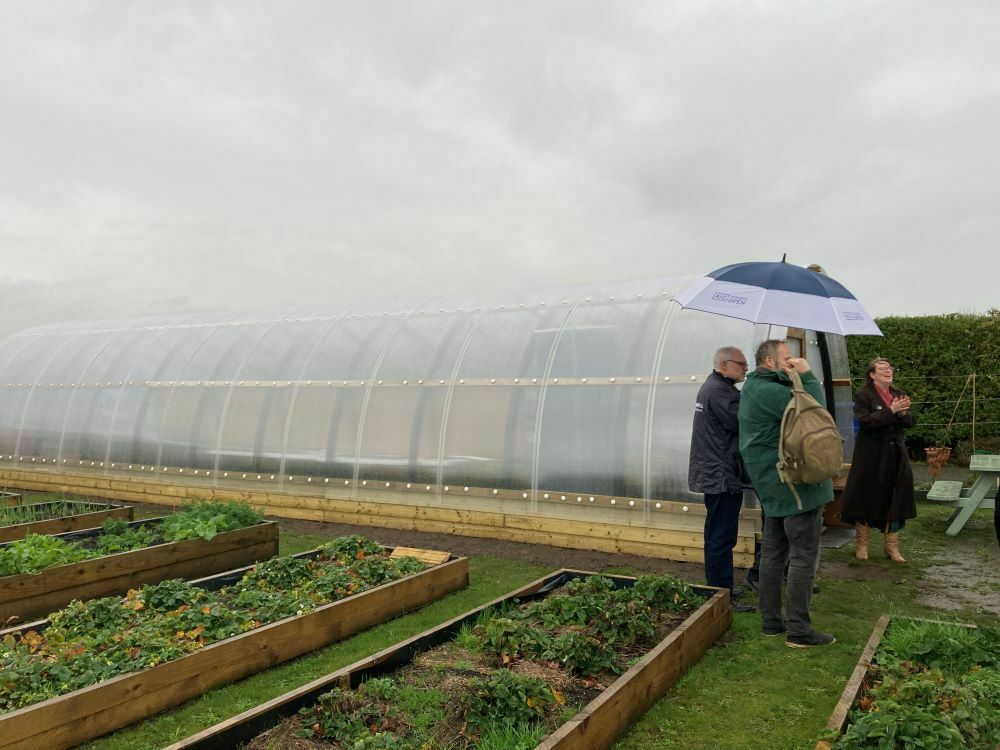
Part of the grant that MAEDT received from the Communities Mental Health and Wellbeing Fund was used to pay for MAEDT’s Enterprise Development Worker, so that the Pavillion could open more often. The funding also paid for a structure in the garden called a Polycrub, as well as a pergola, making the expansion of gardening projects for volunteers possible.
What next?
MAEDT is always looking to the future and thinking about what the community in Mayfield and Easthouses will need next. Aside from the impending cost of living crisis and responding to what looks set to be a difficult winter, ideas for upcoming projects include a sensory park, an electronic rickshaw, and collaboration with partner organisations to embed the pantry model in other areas. For other places in Midlothian to set up their own pantry initiative, a large, centralised project would need to be organised to ensure that food is being dispersed equally. Sharon’s idea would be to use MEADT’s Pavilion as the central location for donations, and to use it as a network hub for distribution.
Reaching this point has taken several years of hard work from MAEDT volunteers and those who work for the organisation in a paid capacity, but it certainly seems as though all the hard work has been worth it. We applaud the team for their worthwhile efforts, and we look forward to supporting the Trust with its ongoing development in the years ahead.
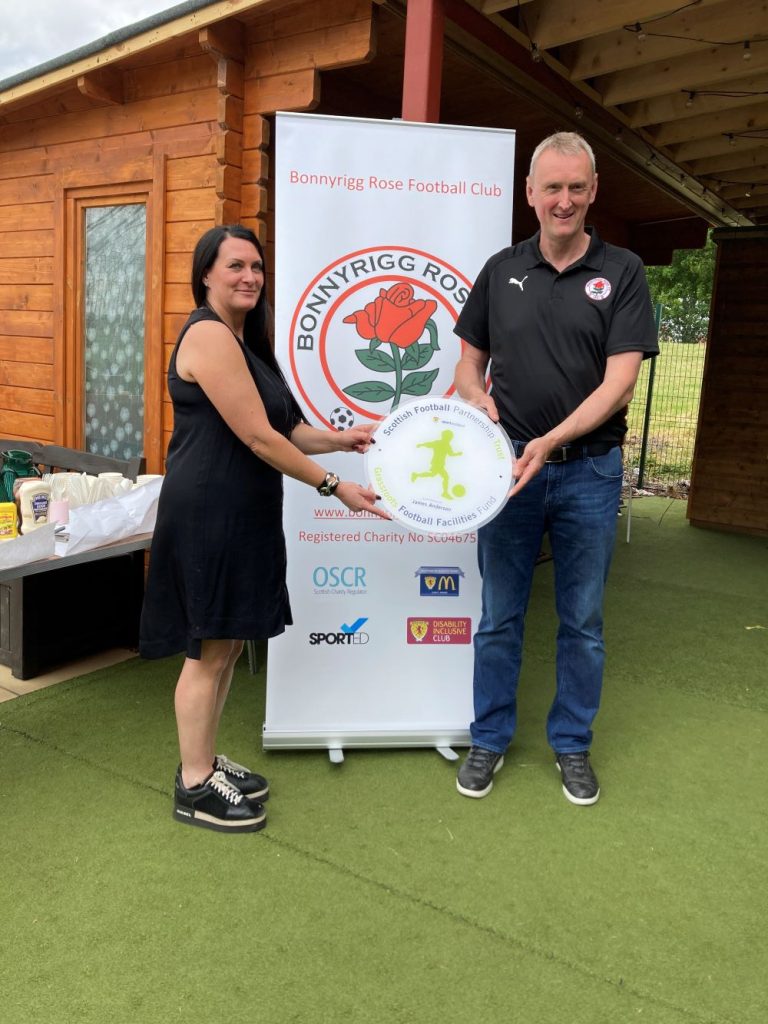
Bonnyrigg Rose Community FC (CFC) is a football club that is gaining recognition for its work championing mental health and wellbeing in Midlothian. As such, it was one of four local charities to receive a larger grant from the Midlothian Communities Mental Health and Wellbeing Fund in 2022. A total of £36,884 was awarded via Midlothian Third Sector Interface to enable the ongoing development of services for local people, including peer support groups, mental health training courses and refurbishments to the club’s community hub building.
The way the BRCFC’s staff and trustees see it, football and mental health are deeply inter-connected. It wasn’t always this way however, because prior to 2019 the club’s main concern had been to ensure that its ageing astro-pitch was replaced. Community programmes were seen as being important, but up until that point they had been viewed as more of a side project to football related activities.
A pivotal moment came when the club held a special one-off community event in the summer of 2019, with the input of Midlothian Council’s Communities and Lifelong Learning team. At the event local people were asked about what their town needed and what they wanted from the club, by completing a survey tool known as the ‘Place Standard’. The responses gathered highlighted that Bonnyrigg lacked groups and activities for older people, as well as needing more targeted opportunities for young people. It also became clear that the club had the potential to play a role in championing grassroots mental health initiatives. This meant moving beyond a focus on sport alone, embedding themes such as wellbeing and connectedness more deeply throughout the club’s community programmes.
Trish Sime (Development Manager) and Jim Wilson (General Manager).
Since 2019 the club has worked with organisations such as Health in Mind to expand the delivery of initiatives including ‘Midlothian Men Matter’. BRCFC’s premises also provides space for several groups which help to reduce loneliness and isolation among local people. Given the high rates of suicide among young men in Scotland and the club’s ability to reach this target group through football and sport, an key date in the calendar for Bonnyrigg Rose is Suicide Prevention Week, which takes place every year in September. To raise awareness of this issue, the club has hosted free Mental Health First Aid training for anyone in Midlothian with an interest in attending. Group based coaching work with younger men who are struggling to cope has also been a feature of the club’s provision over the past 18 months, alongside school-based wellbeing programmes, yoga, free counselling and peer support activities.
We caught up with Trish Sime (Development Manager) and Jim Wilson (General Manager), a few months after they received the club’s grant from the Communities Mental Health and Wellbeing Fund, to find out what has been achieved so far. Trish and Jim explained that the Fund has given them more freedom to continue linking football and mental health together by giving them additional resources – including core staffing hours – to focus in on progressing their plans for more community-based provision. Knowing that physical space is a particularly important resource and in short supply, the club got to work quickly in using their capital grant to replace old windows in the community hub building, making it a warmer and more welcoming facility. By investing in physical spaces where people can connect with each other more, the club is paving the way for further investments in community mental health and wellbeing.
Having charted the huge efforts made by BRCFC to support mental health and wellbeing in Midlothian, the Union of European Football Associations (UEFA) found that the impact of community participation in the club was worth an amazing £3.95 million. This commendable achievement is underpinned by UEFA’s commitment to support the club and its activities in the longer term, helping to build an even stronger foundation for the involvement of the community in helping to decide on future priorities (not just those that related to football)
Speaking about the connection between sport, community and mental health, Trish Sime told us:
“Sport brings people together. Through teamwork and a positive attitude, relationships are fostered, and trust is created. People rely on their teammates, friends, and peers to help them through challenges – both on the field and off. Using the power of football and sport in general to talk openly about mental health and to break the stigma is positive, and it’s the right thing to do.”
Trish Sime
We couldn’t say it better than that, and we’re keen to see what comes next for the club because the future for BRCFC looks bright. You can follow BRCFC on Twitter or check out the main BRFC club website for more info about what they are up to.